Challenge: Think of a location that your thesis project could be displayed, exhibited, disseminated, installed, shop-dropped (http://shopdropping.net/), placed, hidden, mounted, projected, inserted, etc. that is outside the traditional gallery setting.
I think it would be interesting for my thesis project to be displayed either in a venue at a concert, or at a music festival just somewhere randomly on a path. It would be appealing to the right crowd and it would be cool to watch peoples' reactions as they walk by. I think in this scene, it would be more likely that people would actually stop to look at the detail in the images. in the venue, it would be nice because there would be walls and there would be more of a way to secure them and make sure nobody disturbed them. The same could happen in a music festival setting, but I feel that I would need to be more creative in how I would secure them and display them...maybe bring a standing wall and display them on it. This could actually be a possibility...as I will be going to a few festivals this summer. It would be really cool to display 10-15 of them all in one straight line on a wall randomly somewhere on the path to a stage or something!
Many artists and photographers hope that their work engages with a larger audience outside of the museum/gallery/art&design school system. Describe how your project relates to a discipline or realm outside of art. For example, does it relate to the ideas learned through the study of human behavior/psychology or perception, preservation of wildlife, technological advancements in engineering, the anthropological study of humans and their relationship with the idea of time, outsider art, visitors to natural history museums, popular media audiences, etc? How might your work engage with this type of viewer if you presented it outside of the gallery context? How might your project engage with this type of viewer within the gallery context?
Whoa, this is quite a question! My thesis relates to self-similarity, and the idea of differences within one thing. I am trying to this what this relates to on a larger scale, outside of the art world...hmmm.
Well, with my thesis, I am trying to show that there is more than one way to look at something...so maybe it could translate into the realm of poetry, in the sense that one single poem can be translated into different meanings...we can get multiple messages from one passage, just as I get multiple images from one image. I think if I presented these works to a poet, he/she may see it as a series of stories or messages...
I believe that this particular viewer would get the same general idea from it both inside and outside the gallery setting. Though if it were outside the gallery setting (in my setting that I so desired above) I believe it would be viewed more as an aesthetic than a meaning...
This may be far fetched, but I tried! This is a really good question..I wish I had a better answer...
Sunday, April 10, 2011

Thursday, April 7, 2011
Redefinition


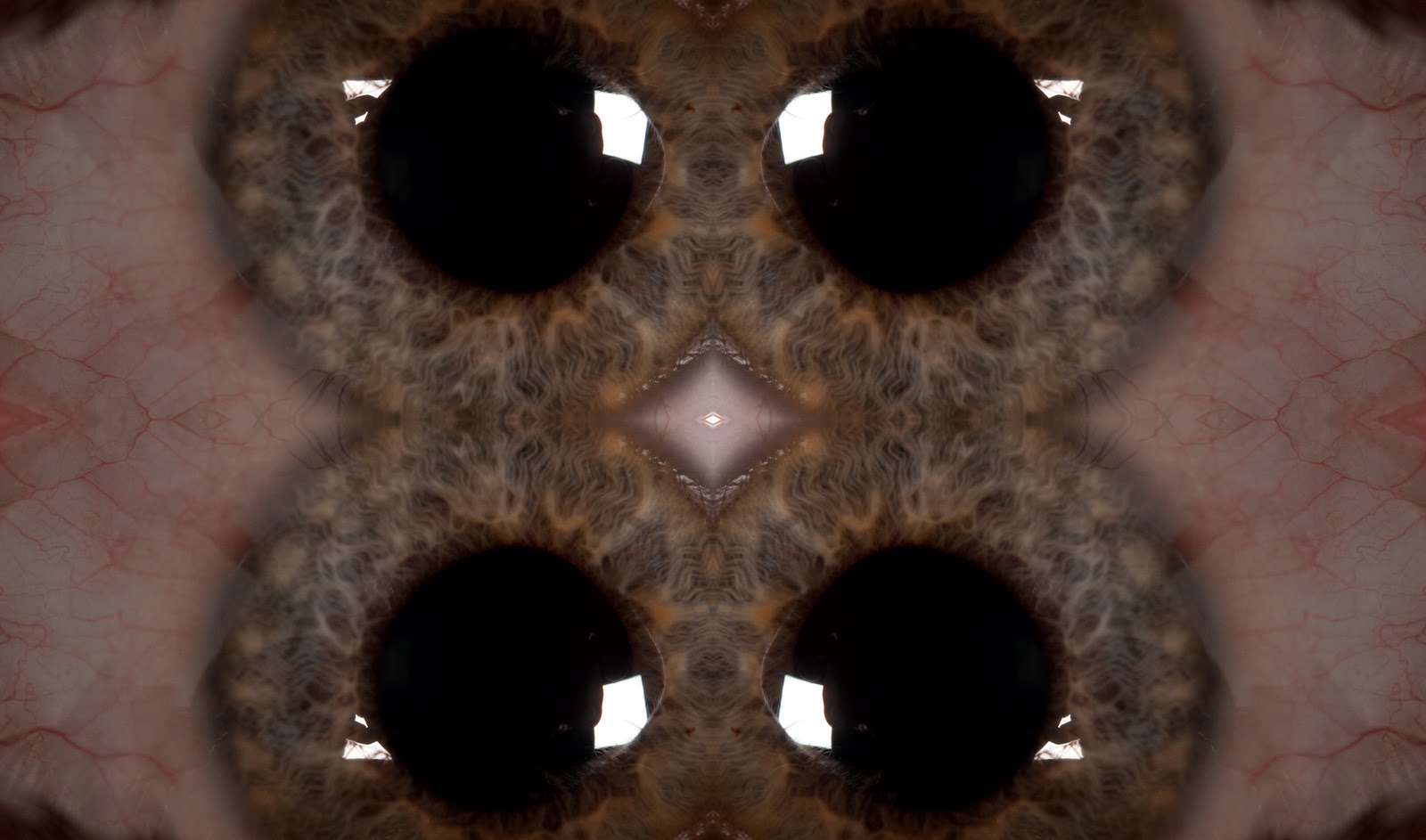
I am redefining the subject by reflecting it over itself in four different ways. By doing this I aspire to show that the subject can translate into different behaviors while still maintaining its same original quality. In this, I am showing that there are different aspects to every one thing.
Monday, April 4, 2011
Photo Presentation #6
Robert Flick
Born in 1939 in Amersfoot, The Netherlands. Flick is a John Simon Guggenheim Memorial Fellow. He lives in LA, where he developed one of the most interesting photography series of all time (in my opinion), Sequential Views. Here, he uses a video camera to capture stills, tons of them. He set up his camera on his car window and took a large series of stills at different times while he was driving through LA. He then takes all of the images and creates an ordered grid, showing all the images together as one long story. This is a really cool idea---I have always wanted to set my camera up in my car and take long exposures of the highway at night time...this is a little different than what he does, but somewhat similar subject matter. This idea is really cool and very well executed!!!!


Jerry Uelsmann
One of my FAVORITE photographers of all time.
Born in Detroit in 1934 and received his BFA at the Rochester Institute of Technology and his MFA at Indiana University in 1960. He is the recipient of a Guggenheim Fellowship and a Nat'l Endowment for the Arts Fellowship. He works mainly with film, and is known for his amazing layering work in the darkroom. He is an incredibly well-known photographer, and has the most awesome style of any photographer that I have ever come across.
The best attribute of his photography takes place in the darkroom; he is incredibly good at taking different objects and morphing them into one another and making them all connect to one another. He is good at making everything "one". I have always wanted to do a project relative to what he does...I still need to do this!!


Born in 1939 in Amersfoot, The Netherlands. Flick is a John Simon Guggenheim Memorial Fellow. He lives in LA, where he developed one of the most interesting photography series of all time (in my opinion), Sequential Views. Here, he uses a video camera to capture stills, tons of them. He set up his camera on his car window and took a large series of stills at different times while he was driving through LA. He then takes all of the images and creates an ordered grid, showing all the images together as one long story. This is a really cool idea---I have always wanted to set my camera up in my car and take long exposures of the highway at night time...this is a little different than what he does, but somewhat similar subject matter. This idea is really cool and very well executed!!!!

Near Live Oak

Along Speedway

Long Beach Harbor

...This one is in Illinois
Jerry Uelsmann
One of my FAVORITE photographers of all time.
Born in Detroit in 1934 and received his BFA at the Rochester Institute of Technology and his MFA at Indiana University in 1960. He is the recipient of a Guggenheim Fellowship and a Nat'l Endowment for the Arts Fellowship. He works mainly with film, and is known for his amazing layering work in the darkroom. He is an incredibly well-known photographer, and has the most awesome style of any photographer that I have ever come across.
The best attribute of his photography takes place in the darkroom; he is incredibly good at taking different objects and morphing them into one another and making them all connect to one another. He is good at making everything "one". I have always wanted to do a project relative to what he does...I still need to do this!!
Photo Presentation #5
Guy Bourdin
Actually named Guy Louis Banares, he was born in Paris in 1928 and died in Paris as well in 1991. He was a fashion photographer with a very pecuilar style. He got his start in photography while he aws a cadet in the French Air Force. The first fashion photographs he ever took were published in french Vogue in 1955, a magazine at which he worked until 1987.
Some of his photographs (on his website) are very different from anything I have ever seen. For example, the image of the nude woman in the studio where her figure is distorted is insane! I really want to know how he does this. It seems like either some sort of strange and bizzare glass figure in between the camera and the subject, but I cannot figure it out! His other photograph that is interesting to me, the image under Beauty of the girl looking through the goldfish bowl looks somewhat like a Surrealist, Dali-like painting, where the image of one thing, an eye, plays into and takes form with the glass.
His stuff is really different, and I really enjoy his perspective of photography.
Duane Michals
Born February 18, 1932, he is a photographer who is mainly self-taught. Michals received his BA from the University of Denver in 1953. He worked mainly with commercial photography for a long time. He tended to take photographs of people in their enviromments, mainly because he didn't have a studio.
His sequenced photographs are his most interesting. One of my favorite things about his sequences is the stories within them. Some are more obvious than others, and some are more related to feeling than others. For example, the Chanced Meeting is interesting because it shows that moment that you tend to see in movies, where two people say goodbye and walk away, one looks back then the other does, both at different times, and neither knows. What is different about this one is that the two are strangers and both share a moment in which they connect, though they are not aware that the other has felt the same moment. His way of telling a story through multiple photograhs is what I like about him most.


Actually named Guy Louis Banares, he was born in Paris in 1928 and died in Paris as well in 1991. He was a fashion photographer with a very pecuilar style. He got his start in photography while he aws a cadet in the French Air Force. The first fashion photographs he ever took were published in french Vogue in 1955, a magazine at which he worked until 1987.
Some of his photographs (on his website) are very different from anything I have ever seen. For example, the image of the nude woman in the studio where her figure is distorted is insane! I really want to know how he does this. It seems like either some sort of strange and bizzare glass figure in between the camera and the subject, but I cannot figure it out! His other photograph that is interesting to me, the image under Beauty of the girl looking through the goldfish bowl looks somewhat like a Surrealist, Dali-like painting, where the image of one thing, an eye, plays into and takes form with the glass.
His stuff is really different, and I really enjoy his perspective of photography.
Duane Michals
Born February 18, 1932, he is a photographer who is mainly self-taught. Michals received his BA from the University of Denver in 1953. He worked mainly with commercial photography for a long time. He tended to take photographs of people in their enviromments, mainly because he didn't have a studio.
His sequenced photographs are his most interesting. One of my favorite things about his sequences is the stories within them. Some are more obvious than others, and some are more related to feeling than others. For example, the Chanced Meeting is interesting because it shows that moment that you tend to see in movies, where two people say goodbye and walk away, one looks back then the other does, both at different times, and neither knows. What is different about this one is that the two are strangers and both share a moment in which they connect, though they are not aware that the other has felt the same moment. His way of telling a story through multiple photograhs is what I like about him most.

Monday, March 28, 2011
Blog Prompt #23
1. What is the concept driving your thesis project at this point in the semester? Has your concept changed since the beginning of the semester? If so, describe the changes?
The concept driving my thesis project is the idea that just as we as humans have multiple components that make up our personalities, there are multiple sides to other forms of nature. Though you can view something in more than one way, it will still hold similarities to the other elements that make up its whole. (I tried to make this as contrite as possible, if I need to extend this, please let me know)
My concept has changed a bit in the sense that I am steering a bit away from saying that I am creating order from disorder. I am still doing this, but I am doing it in order to prove my point about there being many sides to one thing. I am trying to relate the aspect of the colorful and ever changing human to the things in nature and in life that only seem stagnant and always the same.
2. How has your process of experimentation and image creation throughout the semester expanded, redirected, altered, or tightened your concept?
My process of image creation has essentially stayed the same: creating four images from one image. However my process of capturing the images has changed: instead of taking an image and then zooming into it to explore and find an image to work with, I am now shooting with the intent of not cropping and keeping the image from the start. I have found that working with subject matter that I find outside (trees, clouds, decaying sidewalks, bark, etc.) is more interesting to shoot because I can find line and form by looking through the lens and formulating my idea while I am shooting the image. Now that I can somewhat know what the image may look like, I feel this process is more beneficial than the former.
3. How has your process of experimentation and image creation throughout the semester affected the visual aspects of your work?
Describe how the visual aspects of your project align with the content and concept of your project. Are there ways in which they seem contrary to your concept? How might you tackle this misalignment?
My process of experimentation has mainly been through the way that I capture the initial image and the type of subject matter with which I choose to work. I have decided that more natural imagery looks more appealing, as there are more intricacies that can arise from the type of line and form that I have come across. From this, the images as a whole have become more visually uniform. From working with more natural imagery I have found the images to be more intricate and aesthetically pleasing than the synthetic imagery that I was originally using.
The visual aspects of my project align with my concept quite well, I believe. From looking at each of the four images you can see similarities between them all and you can also see a difference between each of them as well. This reflects the idea of our multiple aspects to our single self and the fact that images and similarities can mirror between them, but at the same time, there are distinct differences between them. Nonetheless, they all come from the same one thing, so they are all essentially the same in that sense. I am not sure if there is anything that may seem contrary…I could be wrong, so if I am, please tell me! I would love to know so that I can be aware of it…
Sunday, March 20, 2011
Blog Prompt #22
In response to the making of Jim Fiscus' "The Unfortunate Moment of Misunderstanding"...
To be honest, I had to replay the beginning two minutes of this video in order to re-grasp his concept. His concept did not interest me so much as the process did (that is, the combination of photography with 3D imagery (with CG). I am not really sure what CG is, but it sounds awesome. Someone telling me that I could think of pretty much any idea / photographic process, and be able to make it possible, is phenomenal. It is amazing where technology has gone, and where it is going. Someone in the video also said that CG may change technology forever, and I would probably have to agree. I do not know where this technology will take us, but I am certain it will create a type of imagery that has not yet been fathomed---which is really awesome in my book!
To be honest, I had to replay the beginning two minutes of this video in order to re-grasp his concept. His concept did not interest me so much as the process did (that is, the combination of photography with 3D imagery (with CG). I am not really sure what CG is, but it sounds awesome. Someone telling me that I could think of pretty much any idea / photographic process, and be able to make it possible, is phenomenal. It is amazing where technology has gone, and where it is going. Someone in the video also said that CG may change technology forever, and I would probably have to agree. I do not know where this technology will take us, but I am certain it will create a type of imagery that has not yet been fathomed---which is really awesome in my book!
Wednesday, March 16, 2011
Photo Presentation #4
Thomas Ruff
Thomas Ruff was born in 1958 in Zell am Harmersbach, Germany and currently lives and works in Dusseldorf, Germany. His work is very varied, as he has done series of photographs of buildings, nudes, etc. He also has done a series called "Cassini" which are based on photographic images of Saturn by NASA. The Cassini series is my favorite of his, though it is unclear whether he used NASA's actual images, or whether he recreated images based on these images. He also did a series called Zycles, which are 3D renderings of mathematical curves that were based on engravings that he found in a book on electromagnetism. I am assuming he actually made these, but I am unsure about the Cassini ones.


Thomas Ruff was born in 1958 in Zell am Harmersbach, Germany and currently lives and works in Dusseldorf, Germany. His work is very varied, as he has done series of photographs of buildings, nudes, etc. He also has done a series called "Cassini" which are based on photographic images of Saturn by NASA. The Cassini series is my favorite of his, though it is unclear whether he used NASA's actual images, or whether he recreated images based on these images. He also did a series called Zycles, which are 3D renderings of mathematical curves that were based on engravings that he found in a book on electromagnetism. I am assuming he actually made these, but I am unsure about the Cassini ones.

Nick Knight
Currently residing in London, he is the founder and director of SHOWstudio.com, which is a website that displays live fashion shows and is also a good resource for all those who pertain to the fashion world (there is a blog, resources, agent link, etc.) It is essentially a fashion broadcasting website. In 1982 he published his first book of fashion photographs, Skinheads. Throughout his career he has challenged the ideas of the fashion world and the stereotypical views of what is beautiful.
http://nickknight.com/main.html
Peter Hujar
Born in October 1934 in Trenton, NJ, Peter Hujar is known for his black and white photography. He eventually moved to Manhattan to launch his career. His most famous photograph is Candy Darling on her Deathbed. It was used late on by the musical group Antony and the Johnsons on their album cover for "I am a Bird Now". Hujar died of AIDS in 1987.

Subscribe to:
Posts (Atom)